

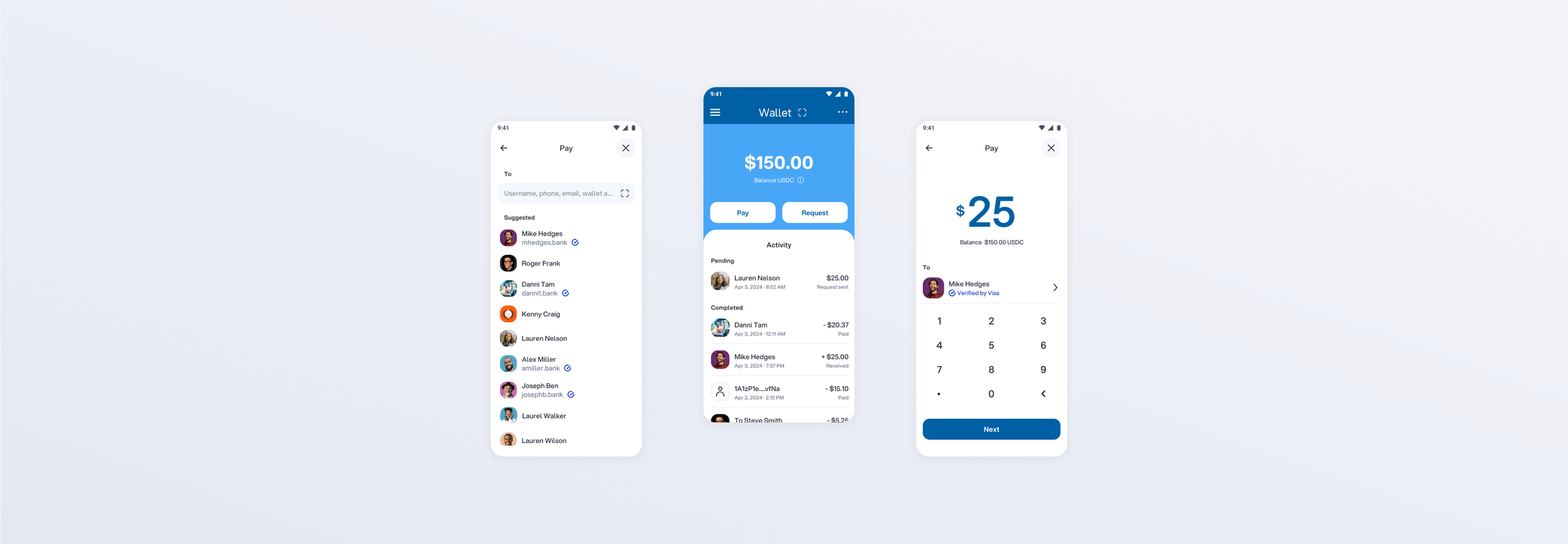
Crypto Wallet: A White-Label Solution for Financial Institutions
At Visa, I worked collaboratively to ship V1 of a mobile crypto wallet for financial institutions and their customers.
Project introduction
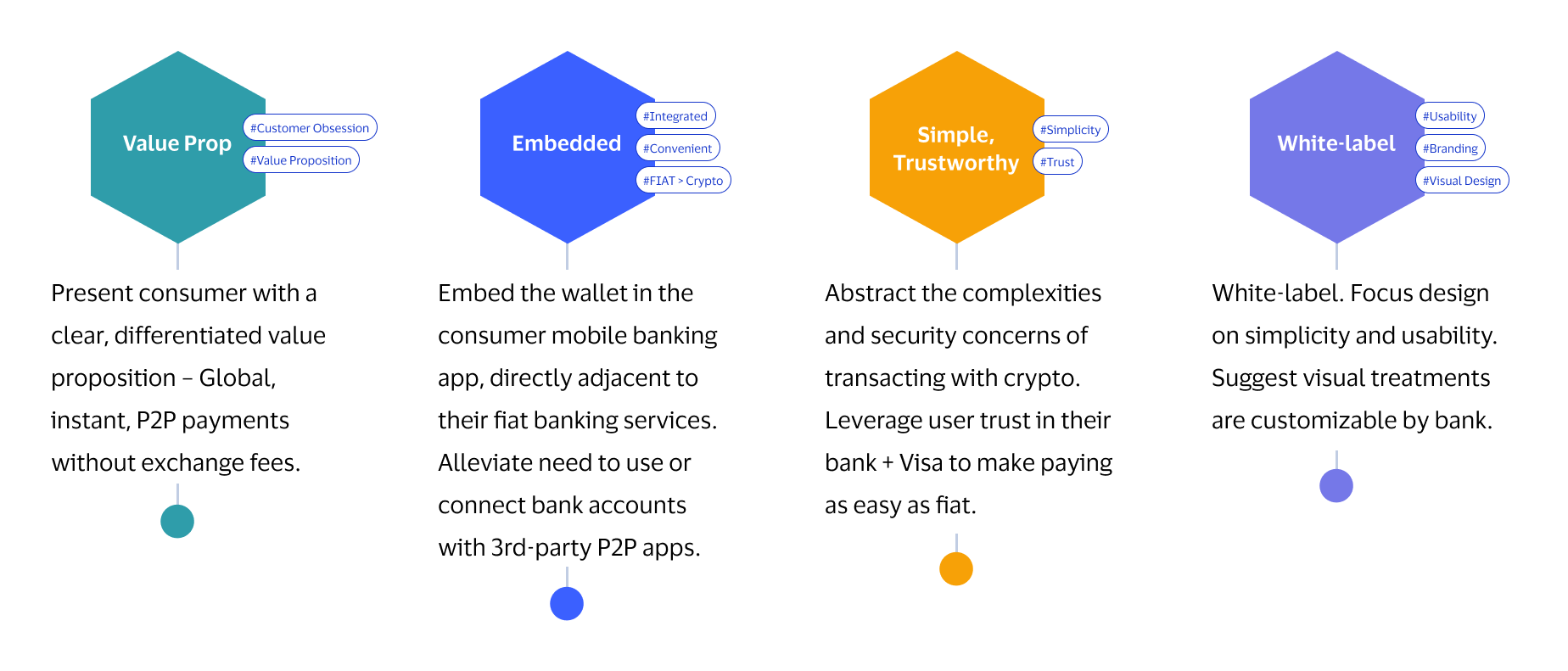
For this project at Visa, we set out to design a white-label mobile crypto wallet solution to empower financial institutions to offer a cobranded, trustworthy and accessible crypto wallet to their customers. By leveraging Visa’s established brand, our goal was to create a secure and user-friendly experience that encourages broader adoption and usage of crypto assets while providing users with the same trust they associate with Visa.
My team
My role involved discovery, user research, journey mapping, creating personas, wire-framing, low to hi-fidelity designs, presentations, prototyping, user testing, dev hand-off
In collaboration with 2 product designers, product & engineering partners
What is a crypto wallet?
A crypto wallet allows users to store, send, and receive cryptocurrencies. Unlike traditional wallets, it doesn’t physically store currency but securely manages digital keys allowing users access and control of their digital assets. Our goal was to create a product that blended simplicity and security while adhering to Visa’s brand standards and offering the flexibility needed for institutional customization.
User research: guiding the design
User research was a cornerstone of our process in designing the mobile crypto wallet. Collaborating with the user research team, we worked to identify the most impactful questions and research methods to uncover user needs and expectations.
Recruitment & Execution
To ensure a well-rounded understanding of our users, we conducted 40 moderated 1-hour interviews on UserTesting.com.
We prioritized diversity by including participants with varying:
Demographics: Participants were recruited from five different countries, offering a global perspective on crypto adoption and user behavior. A mix of ages and genders were included to capture a broad user base.
Crypto Experience Levels:
Active Users: Highly engaged users who frequently interact with crypto wallets.
Passive Users: Infrequent users with basic crypto knowledge.
Curious/Skeptics: Individuals with little to no knowledge of crypto, often hesitant or skeptical about using it.
This foundational research helped us define the core features and guided the initial design phase.
Process & collaboration
Working closely with product managers, we scoped our target users, aligned user needs with business goals and institutional requirements. Collaboration with engineers was also integral as we identified technical limitations and mapped out potential technical considerations and API integrations. Together, we addressed constraints and designed scalable solutions to ensure functionality and smooth integration with existing systems.
Design & Iteration
We followed a collaborative design approach, cycling through ideation, iteration and feedback. Our process included regular design critiques and presentations, which allowed my team to share progress and gather insights with our stakeholders to refine our design solution. This iterative loop enabled us to optimize the user experience as well as adapt the product to meet technical requirements and business needs.
Outcome
The project is currently developed into a high-fidelity clickable, functional prototype in Figma. This prototype serves as the blueprint for our final user testing and provides our development team with a clear foundation for the build phase.
Feel free to check out my clickable prototype as well: