

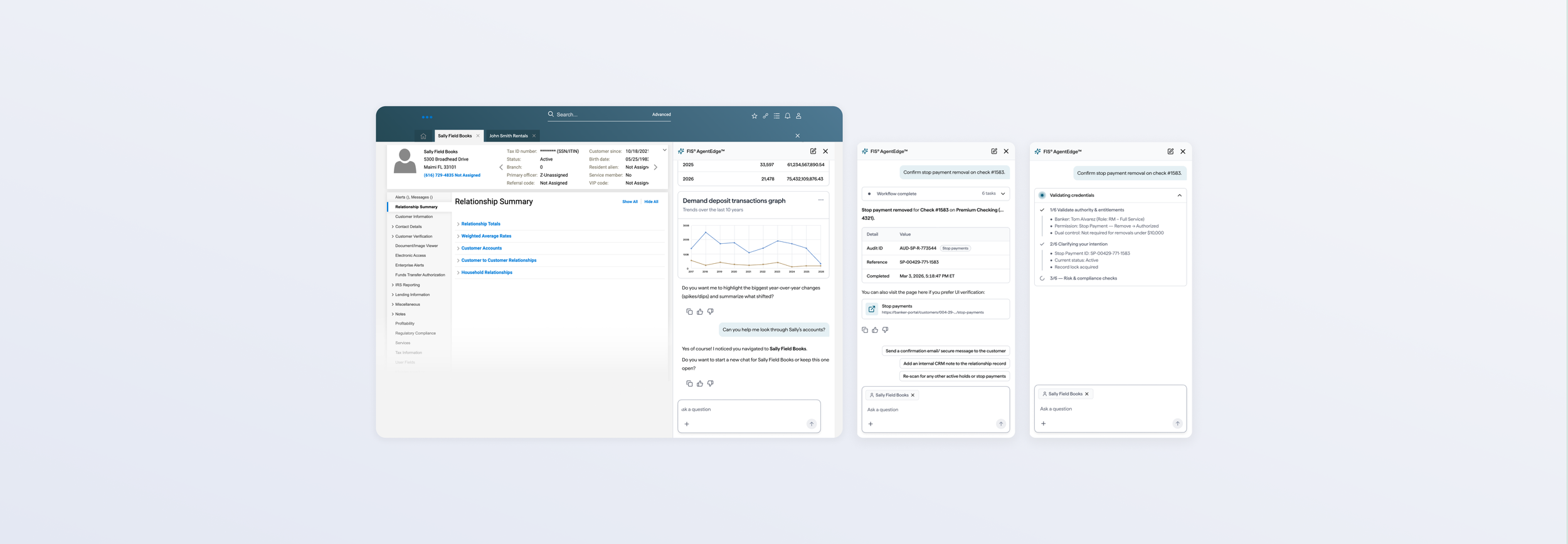
AgentEdge 2.0: AI Chat Assistant
At FIS, I led the end-to-end design of AgentEdge 2.0, reimagining AI assistance for bankers through an embedded AI assistant chatbot experience.
Project introduction
AgentEdge 2.0 is an AI-powered assistant experience designed to integrate directly into existing FIS banking platforms. Built as an embedded copilot-style experience, the product enables bankers to access AI assistance without disrupting their existing workflows.
The platform helps bankers navigate complex systems, summarize information, automate repetitive tasks, and reduce friction caused by multi-step workflows. Rather than functioning as a separate standalone product, AgentEdge 2.0 was intentionally designed as an integrated layer within existing banking tools, making AI feel like a natural extension of the banker’s workflow.
This project was created as a strategic pivot from AgentEdge 1.0 after early beta feedback revealed adoption and scalability challenges.
My role
Lead Product Designer
I led the end-to-end UX design process for the AgentEdge 2.0 MVP, collaborating closely with product, engineering, and design systems teams.
My responsibilities included:
Translating user research and product requirements into UX concepts
Designing the embedded AI assistant experience across banking workflows
Creating low, mid, and high-fidelity wireframes and prototypes
Leading design critiques and cross-functional collaboration sessions
Partnering with engineering on feasibility and implementation
Helping define AI interaction patterns and components for the company’s design system
Supporting developer handoff and QA throughout production
The challenge
AgentEdge 1.0 was initially launched as a standalone AI-powered banking platform. While the product generated strong interest during early testing, the beta phase revealed two major challenges:
Adoption barriers — Bankers viewed the platform as a separate product they would need to learn, purchase, and integrate into their daily workflows.
Operational scalability — The cost to operate and maintain the standalone platform outweighed projected adoption and revenue opportunities.
Rather than continuing to scale a disconnected AI platform, the team used this feedback as an opportunity to reassess how AI could better fit into bankers’ existing behaviors and workflows.
The key insight:
Bankers did not want another platform. They wanted intelligent assistance built directly into the tools they already use.
This became the foundation for AgentEdge 2.0.

Defining the opportunity
Because AgentEdge 1.0 had already undergone extensive user research and beta testing, we were able to leverage existing insights to rapidly define the direction for the new product.
We revisited previous research focused on:
Banker workflow pain points
Friction caused by complex multi-page navigation
Trust and partnership sentiment between bankers and AI
User expectations around AI assistance in financial environments
Areas where automation could reduce cognitive load and repetitive work
These learnings helped shape the product requirements and informed how AI should appear within existing FIS-native experiences.
Instead of replacing workflows, AgentEdge 2.0 was designed to support and enhance them.
Product strategy & collaboration
Working closely with product management, the team developed a PRD focused on delivering an MVP beta within a highly accelerated 2-month timeline.
Given the speed of development, collaboration and prioritization became critical to the project’s success.
Throughout the project, I worked in a highly iterative cycle involving:
Internal design critiques with the UX design team
Cross-functional review sessions with product and engineering
Technical feasibility discussions with developers
Ongoing alignment around MVP scope and prioritization
Design systems collaboration to establish emerging AI patterns and high craft
Because AI experiences were still relatively new within the organization, this project also became an opportunity to help define how conversational AI components and interaction patterns could scale across future FIS products.
Design process
I explored how an AI assistant could naturally integrate into existing banking workflows without disrupting critical tasks. Early concepts focused on interaction patterns such as side panels, chat overlays, contextual assistance, and conversational task flows while considering how AI could surface summaries, recommendations, automation, and workflow shortcuts.
As the product direction became more defined, my designs evolved from low-fidelity concepts into production-ready high-fidelity wireframes and prototypes through ongoing collaboration with product, engineering, and design systems teams.
Designing for AI in Banking
Because bankers operate in highly sensitive financial environments, trust and usability were central to the experience. The AI assistant was designed to feel transparent, reliable, and assistive, helping users navigate systems, summarize information, and reduce repetitive multi-step workflows while maintaining control and a human-in-the-loop experience.
The project also helped establish foundational AI interaction patterns and components for the company’s evolving design system.
Execution & Delivery
Within a rapid 2-month MVP timeline, I led the experience from concept through production handoff, collaborating closely with engineering during implementation and QA.
To validate assumptions before launch, I created interactive prototypes embedded withihn sample FIS-native products, allowing stakeholders and early users to test realistic workflows and inform final UX refinements prior to beta release.
Outcome
AgentEdge 2.0 successfully evolved the original standalone AI concept into an embedded assistant experience designed around existing banker workflows.
The project transformed key learnings from AgentEdge 1.0 into a more scalable and adoption-focused product strategy by:
Reducing friction to AI adoption
Embedding AI directly into familiar workflows
Creating reusable AI interaction patterns for future FIS products
Establishing foundational AI components within the design system
Delivering a production-ready MVP within a 2-month timeline
The product has now been developed and is being introduced to early adopters for beta testing. Current efforts are focused on gathering feedback, measuring adoption, and prioritizing future enhancements and backlog features for future releases.
Reflections
This project reinforced the importance of designing AI experiences around existing user behavior rather than expecting users to adopt entirely new workflows.
It also highlighted the importance of:
Rapid iteration and prioritization
Cross-functional collaboration under tight timelines
Designing trustworthy AI experiences in sensitive industries
Creating scalable AI interaction patterns within enterprise ecosystems
Most importantly, the project demonstrated how strategic product pivots informed by user feedback can create significantly stronger user experiences and product outcomes.